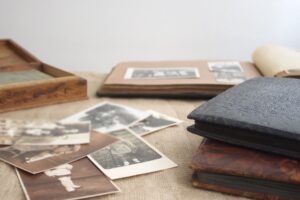
You’re thinking that nobody would publish a book that potentially has little interest to the book buying public and that’s probably true, but these days its possible to self-publish at relatively little cost. Web sites like lulu.com offer such a service and you can get a handful of copies printed, allow people to buy their own, even make it available on Amazon if you get an ISBN. With epublishing and Apple inviting authors to self publish for the Ipad there is a an exciting democratisation within publishing taking place giving many more people the opportunity to share their work.
You may have the intention to write up all your work when you’ve finished your research. This was always my plan, until I realised that this research will never be finished. Silly me! As the years go by more records are unearthed and made available and the chase resumes. You don’t have to stop researching, just make it part of your work to, for example, write something about one ancestor every week. Or document your research in the style of a diary. Just a few hundred words every week and in a year or two you’ll have the ground floor of a book! Start today!
A few years ago I started experimenting with how to present genealogy in something other than a family tree and I combined ‘altered art’ – using an old book, with digital scrapbooking and artist’s trading cards to come up with this:
I found an old book about gardening which seemed the right size and removed some of the pages. I glued the rest of the pages together and to the back board, I then cut out a niche.
I covered the book with mulberry paper, green on the exterior and cream on the interior. I glued aged lace, a photo in a found frame and a buckle. The buckle serves to keep the book closed and to keep the cards in.
I covered the niche and containing page with black lace fabric leaving it to overlap and covered the niche with burgundy crinkled satin-type fabric. I glued a matching ribbon to one side to make it easier to extract the cards.
I glued scraps of tissue newspaper, mulberry paper, a torn photo and a skeleton leaf to the inside front cover.
I made the ATC cards using digital scrapbooking techniques and a mini-book set from fishscraps.com
I’ve found a couple of Victorian soldiers in my line, so far and today I’ve been researching conditions. In a word, grim! Pay was 1s 1d a day (about 5.5p) and out of that they had to pay for food (about 6d/2.5p), uniform and its upkeep, medical expenses and any damages incurred to their accommodation. Barracks were horribly overcrowded, badly lit and heated. Rations were 1lb of meat and 1lb of bread a day, little or no vegetables or dairy produce. Monotonous and ultimately unhealthy. There was a lot of sickness.
Finally I’ve found some time to resurrect the website after a data disaster in 2008. Please bear with me as I upload pictures and generally tidy the database. Please use the links in the sidebar to search the data.
In other news I’m planning to write a book about the Rainbow side of my family tree based on 30 years of research and I’ll be using this blog to document my progress and share information. Please feel free to comment on or query any of the information you find here. I’d love to hear from other Rainbow researchers.
I’m a UK amateur genealogist researching my family on and off for over 30 years. This is my occasional blog about my research into the Rainbow branch of my family history. I’m researching the Leicestershire (Lutterworth)/Coventry Rainbows with my earliest being William Rainbow, married to Phoebe Taylor, father of John Rainbow born Cottesbach, Leicestershire, 1746. William is my brick wall!